

The Management Trap: Why Hiring a Team Doesn’t Always Free You Up

READ TIME: 7 MINUTES

The survey came back. He wrote, “I look up and things are all over the place and I feel like the only way to get things in order is to ctrl-alt-del and start over. Because why is it supposed to be this hard?”

He hired a team. The work was getting done. He was still the one awake at night. 

If that is your week too, you already know the next part. You did the right thing. You hired. And you are busier than ever.

This problem is currently keeping you up at 10:07 p.m. and you aren’t alone. Because you’ve likely walked straight into what many growing business owners don’t see coming: the management trap. 

You followed the advice. Build a team. Buy back your time. And for a while, it worked, because it was supposed to. 

Getting here required hustle and doing most of it yourself. That got you here. 

The problem? The same approach that built the business is now slowing it down. 

The rules change at this stage. That’s not failure. It’s just the next level. 

Key Takeaways

What management actually is

Most owners underestimate management until they are buried in it. 

Management is not “being the boss.” It is making sure work can move without you in every loop. Goals turn into a plan. People know what they own. Handoffs are clear. Progress gets seen through instead of stalling in someone’s inbox — usually yours. 

Put simply: a manager makes sure the right things get done, in the right way, at the right time, by the right people. 

Here is what most owners miss: this is not a people problem. Your team is not the issue. The model is. 

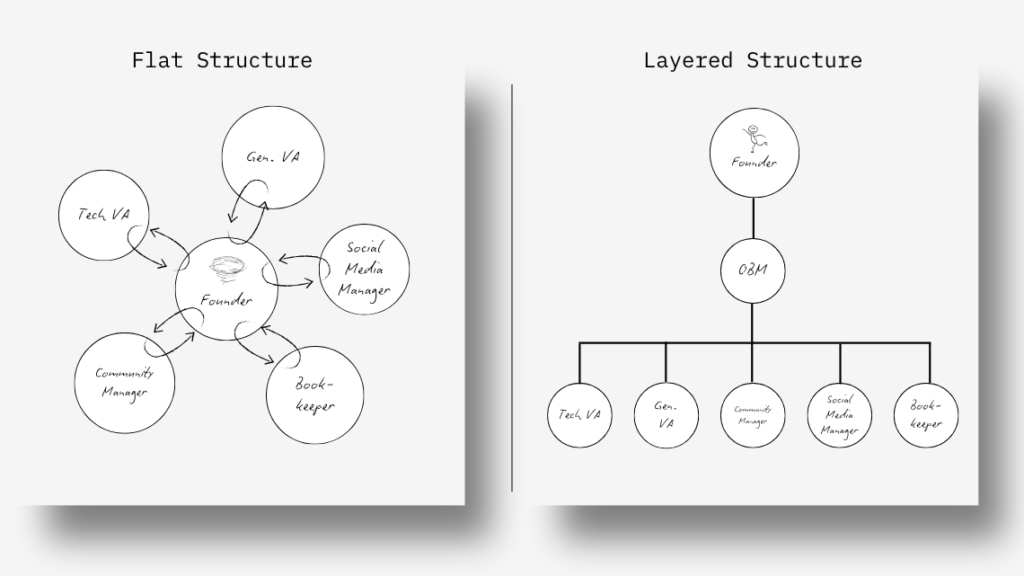
A flat structure makes you the manual bridge between every moving part. Questions, approvals, updates, troubleshooting, and it all flows through you. 

That is not a management style. That is a structural flaw. 

When you were solo, managing yourself was manageable. Each new hire adds a layer: more communication, more clarity, more follow-through, more coordination. 

The bigger the business gets, the more there is to manage, and someone has to do it. And no, AI cannot manage yet. If you do not give that job to a person, it stays yours. 

What this looks like with more than one offer

This gets loud fastest when the business is no longer one offer. A group program is running. Membership billing has its own exceptions. A high-ticket client needs one-off approval. None of those are hard on their own. Together, they create a week of small decisions that only you are allowed to make. 

That is the trap from the inside: you are not doing everyone’s job. You are still the only place work can pass through. 

Why hiring didn't give the time back

Here is where the trap springs. 

Many coaches, course and membership owners, and agency founders hire expecting to reclaim their time. What they get instead is a job they never applied for: daily coordination. 

The week fills with checking in on the team, answering questions, troubleshooting what slipped, and wondering whether the right people are even in the right roles. 

Side-by-side diagram of a flat structure (founder as the central hub for every team member) versus a layered structure (OBM between the founder and the team).

When every question and approval has to route through one person, the structure is the bottleneck. That’s the loop. Not a bad hire. Not a busy week. The path for decisions still ends at you. 

The frustration is not only the workload. It is the mismatch. 

Most visionaries are not built for day-to-day people management. Running the team and growing the business at the same time creates tension. Carry both long enough and both get worse. 

If you do not intentionally give someone the management layer, it lands on you by default. That is hard on you, hard on the team, and hard on the work. 

A note on delegation research

Gallup’s work with Inc. 500 CEOs is useful here, not as a flex — as a picture of the same layer. Founders who scored high on delegator talent generated 33% more revenue than those who scored low, and grew three-year revenue much faster. Most employer-entrepreneurs in the study scored low to limited on that talent to begin with. Source:

Gallup, “Delegating: A Huge Management Challenge for Entrepreneurs”

In plain terms: the owners who build a real layer between themselves and the day-to-day tend to outgrow the ones who stay in every loop. Most never build the layer.

The fix is the layer, not more people on the same wiring

This is the seat an online business manager steps into. 

Not as another task-doer. As the person who owns the operational layer: coordinating the team, keeping projects moving, and building the systems that work actually runs on — so you are not the hub. 

You stay on revenue, vision, and growth. Management does not disappear. It stops flowing through you. 

If you are heading into a launch, a book, a new offer, or you are simply tired of being the bottleneck your team works around, this is the hire that changes the routing. This allows you to step into the CEO seat. 

Frequently asked questions

Is the management trap a sign I hired the wrong people?

Usually not. The trap comes from a flat structure where every decision still routes through the founder, even when the team is capable. Swapping people rarely fixes it if the questions still have nowhere else to land. 

What's the difference between a VA and an OBM?

A virtual assistant executes defined work you still direct. An OBM own the operation layer: how work flows, who owns follow-through, and how the team stays coordinated without using you as the go-between. If you need the full split, read VA vs OBM. 

When should I bring an OBM instead of hiring another specialist?

When the bottleneck is coordination, not necessarily capacity. If you already have the right skills on the team and you are still routing every question and approval, another specialist adds another person who has to come through you. The five signs post is the checklist version of that question. 

What to do with this

You don’t need all five signs, and this article isn’t a hiring decision. It’s a name for the loop. Knowledge is power and half the battle, so the saying goes. 

So before you change anything, measure it. For one work week, keep a tally. Every time something stalls until you answer it, approve, or weigh in, make a mark. Don’t fix anything yet. Just count. 

By Friday you’ll have a number, and that number is the size of the job you never applied for. A handful of marks a day is a blip. Thirty by Friday means you’re already running a management role on top of the one you actually want. 

Either way, you’ll be working from the evidence instead of a feeling. The trap was never about your team. It was about where the work has nowhere else to go. 

Mr. Ctrl-Alt-Del kept the vision seat. He stopped treating management like a job he had to keep. 

If you want to see what type of founder you are in that loop, take the quiz: What Type of Founder Are You? 

Related Post