
VA vs OBM: What's the Difference and Which One Does Your Business Need?

READ TIME: 7 MINUTES

VA vs OBM is usually the wrong first question. The real question is whether you need tasks done, or the day-to-day owned.

You know you need help. The list never ends. People pull in different directions. You spend the week putting out fires so the work can move.

Here’s where a lot of owners get stuck: they hire the wrong kind of support for the problem they actually have.

VA vs OBM: What's the Difference and Which One Does Your Business Need?

A Virtual Assistant (VA) is the right hire when the work is defined and you can still direct it.

An Online Business Manager (OBM) is your second-in-command, the one who takes ownership of the day-to-day so you can finally step out of the weeds. It’s the difference between buying back task hours and buying back the capacity to think.

Key Takeaways

A pattern that shows up again and again

This isn’t one person’s story. It’s the same shape, over and over, in owners who already have help and are still the bottleneck.

Someone at mid-six figures. Courses, a membership, or a service offer that finally has demand. A VA already handles the inbox, the calendar, the podcast uploads, or the newsletter send. Sometimes there’s a second contractor for ads or copy. The owner is still the one who builds the launch timeline, answers the “quick question” in Slack, reviews every handoff, and patches the tech when two tools won’t talk to each other.

So they hire another VA, because hours feel like the shortage. A month later there are more people reporting to them, the same decisions still sitting on their desk, and a new job nobody posted for: project manager of their own team.

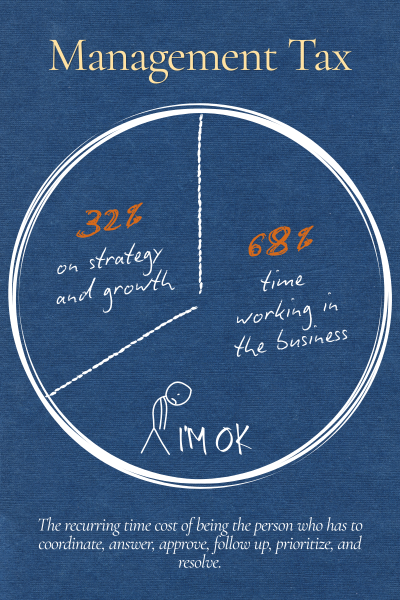
Pie chart showing the Management Tax: 68 percent of founder time spent working in the business versus 32 percent on strategy and growth.

That’s the management tax. And it’s a common tax that an average business owner spends 68% of their time working “in” their business and only 32% of the time working “on” their business.

You save time on the task. You spend it again on direction, review, and follow-up, because nobody owns the plan, only pieces of it.

The VAs didn’t fail. They were hired to execute. The gap was ownership.

A VA is a skilled doer. They handle concrete work, admin, support, scheduling, tech setup, content production, and they do it reliably once the work is defined.

An OBM is a manager and integrator. The role isn’t “senior VA.” It’s oversight of the whole operation: priorities, team coordination, systems people actually use, progress against the plan, and problems caught before they become fires.

VAs help you get things done. An OBM makes sure the right things get done, by the right people, on time, without every thread running back through you.

The core difference: doing vs. managing

Virtual Assistant (VA) Online Business Manager (OBM)
Focus Tactical support and execution. Deep on assigned channels, like the newsletter engine or the tech stack. Operational leadership. Wide across the business: team, systems, projects, and goals.
Ownership Process ownership. Delivers defined processes cleanly. Plan ownership. Delivers the plan and manages the moving parts so you don’t have to.
How you work together You provide vision, direction, and daily management of their workload. They partner on the vision, then manage the team and the timeline to execute it.
What you get back Hours. Tasks leave your plate. Mental capacity. Operations leave your mind.

3 Signs You're Ready for More Than a VA

And these questions only work if you are truly honest with yourself.

01 | What stage is your business really at?

If you’re consistently at six figures, or pushing toward seven, with courses, digital products, a membership, or high-ticket services, and the next twelve months include a launch, a new offer, or more people, you’re usually past “extra hands.” Growth adds pieces. Pieces need coordination, not just execution.

02 | Who's managing the day-to-day right now?

If that’s you, building timelines, chasing deadlines, troubleshooting, getting pulled back in constantly, you’re spending more of the week on coordination than it looks like from the outside. Most owners are genuinely surprised by how much.

Entrepreneurs often spend an average of 36% of their work week on administrative tasks. That’s not a rounding error. It’s nearly four out of every ten hours you work.

Some of that can be delegated, automated, or cut outright. What stays is the management behind it: decisions, accountability, keeping people aligned. Every hour spent as your own operations manager is an hour that doesn’t go into the work only you can do.

03 | Where are you the biggest bottleneck?

Projects wait on your approval. The team circles back for direction on almost everything. You feel reactive because the work can’t move unless you touch it.

That pattern is common at the mid-six-figure mark. The hustle that built the business starts slowing it down. The hard part usually isn’t the budget. It’s handing over control of the day-to-day. As long as that control sits with you, the business is capped at your calendar.

If you want to dig into exactly what that looks like, the management trap is worth a read. 

VAs solve real problems at the right stage. The miss is adding more of them after the problem has already changed, and ending up managing more people on top of the original load.

An OBM takes ownership of the operational side: priorities, coordination, accountability, follow-through. That’s the difference. Skip it, and you’ve built yourself a job, not a machine.

Not Sure Which One You Actually Need Right Now?

Ask yourself what’s really causing the friction:

Hire a VA if:

  • Processes already exist. You need someone to run them reliably.
  • The work is specific and repeating: uploads, scheduling, inbox, a defined content pipeline.
  • You have the bandwidth to direct, review, and manage that workload yourself.

Bring in an OBM if:

  • Everything still flows through you: questions, decisions, bottlenecks.
  • You know what you want to build, but managing the moving pieces keeps landing back on your plate.
  • You need a second-in-command who owns the day-to-day, not another person waiting on a task list.

The Reality Check

Close to one in three entrepreneurs work more than 50 hours a week.

If the week already feels like coordination instead of building, the hours aren’t the only leak. The structure is.

That’s often the exact point where an OBM is the right hire, not because the VA was a bad call, but because the job changed underneath it.

If you want a plain inventory of where operational support actually shows up in a business like this, download, 101+ Ways an OBM Can Help Boost Your Business — a straightforward look at where operational support makes the biggest impact.

The Bottom Line

Business grows. Complexity grows. Management becomes the constraint.

The right support isn’t “more hands” by default. It’s the hire that matches the gap: execution when the work is clear, ownership when the work is already bouncing off you.

Start with the guide above. And if you’re still weighing it, here are five more specific signs it may be time for an OBM.

Related Post